
Vegan Valentines Biscuit Recipe
Rated 5.0 stars by 1 users
Category
Vegan
Servings
14
Prep Time
10 minutes
Cook Time
30 minutes
Calories
120
These heart-shaped Valentine’s biscuits are a sweet way to show someone you care!
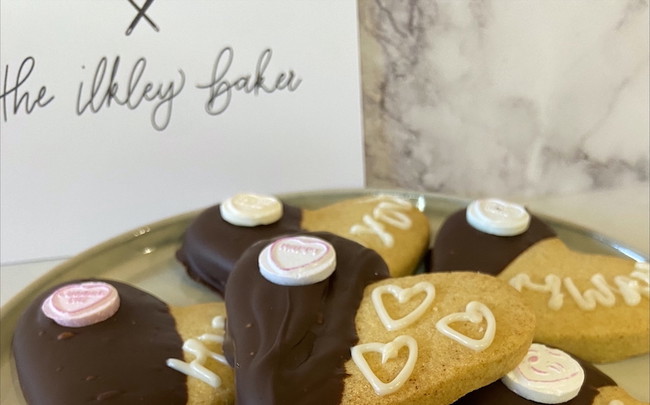
❤️ Made with love and dipped in luxurious Whitakers dark chocolate 🍫, they’re as delicious as they are beautiful.
Perfect for sharing, gifting, or enjoying all to yourself, these biscuits can be easily customised for vegan 🌱 or gluten-free diets.
Decorate them with love heart sweets 💕 or piping messages to add a personal touch—it’s a fun and thoughtful bake for any romantic occasion! 🥰
Ingredients
-
200g butter (can switch to vegan if needed)
-
75g caster sugar
-
150g Self raising flour (can use GF)
-
150g Plain flour (can use GF) - plus some extra for rolling out dough.
-
1tsp vanilla extract
-
100g Whitakers dark chocolate
-
Love heart sweets
-
White Royal icing: mix icing sugar with cold water to a semi thick consistency
Optional for decoration:
Directions
Preheat oven to 150°c.
Line two baking sheets with greaseproof paper.
In a mixer cream the butter and sugar together till smooth and combined.
Add in the vanilla.
Mix through both flours until a dough starts to form.
Knead the dough on a lightly floured surface until it comes together and is nice and smooth.
Roll the dough out into a rough rectangle until an inch thick.
Use a heart shaped cutter to press out shapes and place onto the tray.
Re-roll leftover dough to get more shapes!
The number you get will depend on the size of your cutter.
Bake for 30-35 minutes until lightly golden brown.
Leave to cool on the trays completely.
Once cool, melt the dark chocolate in a bowl.
Dip half of the heart shaped biscuit into the chocolate and place back onto the tray.
Repeat with all the biscuits.
Optional extra decoration:
Place one love heart sweet onto each biscuit on top of the chocolate.
Leave to set.
In a bowl mix some icing sugar with cold water till you get the correct piping consistency.
Spoon into a piping bag.
Cut the very tip off the piping bag and gently squeeze the mixture out to create messages onto the non-chocolate part of the biscuits.
Enjoy!
Recipe Video
Recipe Notes
More Delicious Recipes:
If you have any questions how how to make these simple vegan biscuits for Valentine's Day using this recipe, please post a comment below and we will get back to you.
Servings: The recipe typically yields about 14 scrummy vegan biscuits.
Calories per serving: 120 calories.
Remember: Please tag #whitakerschocolates with photos of your homemade creations.

Nutritional Information
Nutrient | Per Biscuit (approx.) |
|---|---|
Energy | 192 kcal |
Fat | 10 g |
of which saturates | 4.5 g |
Carbohydrate | 24 g |
of which sugars | 12 g |
Fibre | 1.1 g |
Protein | 2.2 g |
Salt | 0.18 g |
Approximate values based on a recipe that makes 12 biscuits. Actual figures can vary with exact ingredients and portion sizes.
The History of Valentine’s Biscuits
Valentine’s Day has a story that stretches back more than two thousand years. In ancient Rome a festival called Lupercalia took place every mid February.
It welcomed the coming of spring and focused on fertility. Young men and women joined in lively rituals that often led to new matches and friendships.
Time passed and the date gained a Christian meaning. A priest called Valentine lived in Rome in the third century. He was put to death for his faith.
Tales say he helped couples marry in secret when the law forbade it. His name and his act of kindness became linked with 14 February.
By the 1400s the idea of romance on this date had taken hold in England and France. People watched birds begin to pair up around the middle of the month.
Poets such as Geoffrey Chaucer wrote about this natural event. The link between the calendar date and matters of the heart grew stronger in British life.
The earliest known written Valentine comes from 1415. A French duke, held prisoner in the Tower of London, sent a poem to his wife. His words of love travelled across distance and hardship.
Soon others began to copy the custom of sending verses and notes.
In Victorian Britain the tradition expanded quickly. Shops offered cards trimmed with lace, ribbons and pressed flowers.
At home, baking became a popular way to show care. Families spent hours preparing sweet biscuits and small cakes.
These handmade gifts carried real warmth because they took time and effort to create.
Chocolate entered the story in a big way during the same era. Richard Cadbury designed the first heart-shaped box in 1868.
It held his family’s chocolates and could be kept afterwards as a keepsake. The box turned chocolate into a lasting symbol of affection on Valentine’s Day.
Biscuits sat comfortably alongside the new chocolate custom. Heart-shaped sugar biscuits or shortbread were simple to bake at home.
They could be left plain or finished with icing, sprinkles or a dip in melted chocolate. A plate of fresh biscuits offered a personal and tasty way to mark the occasion.
Today the custom lives on with fresh ideas. Many bakers now use plant-based ingredients so more people can enjoy the treats.
Vegan butters and milks work well in the dough and still deliver a crisp, golden result. The shapes and decorations keep the fun and meaning alive for new generations.
Whitakers chocolates bring a rich finish to many modern recipes. Their dark chocolate coats the biscuits in a smooth, deep flavour that pairs beautifully with the sweet base.
This meeting of traditional baking and quality chocolate keeps the day both familiar and exciting.
The story of Valentine’s biscuits shows how small, thoughtful acts have endured through the centuries.
From Roman festivals to Victorian kitchens and present-day ovens, the middle of February brings people together over shared sweets.
Baking and giving remain at the centre of the celebration.