
Pistachio Macaron Recipe UK
Rated 5.0 stars by 1 users
Category
Nuts
Servings
10
Prep Time
30 minutes
Cook Time
14 minutes
Calories
180
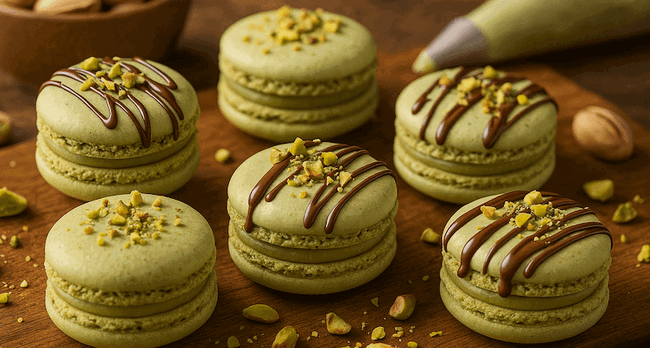
Bring a touch of French patisserie to your kitchen with this UK-tailored pistachio macaron recipe!
Craft delicate, crisp shells with a chewy centre, filled with a smooth, nutty pistachio buttercream.
This detailed guide offers step-by-step instructions, precise measurements, and practical tips to ensure success, from achieving the perfect macaronage to piping uniform shells.
Ideal for bakers of all levels, this recipe helps you create stunning macarons that are as beautiful as they are delicious.
Perfect for afternoon tea, gifting, or simply savouring a moment of sweetness!
Ingredients
-
90g ground almonds (almond flour), very finely ground
-
90g icing sugar
-
2 × large egg whites, at room temperature (about 60g total)
-
30g caster sugar
-
Pinch salt
-
A few drops green gel food colouring (optional)
-
60g unsalted butter, softened to room temperature
-
40g icing sugar, sifted
-
30g pistachio paste (or finely ground pistachios blended to a paste)
-
1 tsp whole milk, to loosen
Macaron Shells
Pistachio Buttercream Filling
Directions
Prep your tray:
Line two baking sheets with non-stick parchment.
If you like perfectly round shells, trace ten 3 cm circles on each sheet, underside of paper.
Sift dry ingredients:
In a bowl, sift together the ground almonds and icing sugar.
Discard any large bits.
Whisk egg whites:
In a clean, grease-free bowl, whisk egg whites with a pinch of salt until foamy.
Gradually add the caster sugar and continue to whisk to stiff, glossy peaks.
If using, add green gel colouring just as the whites start to form peaks.
Macaronage:
Fold one third of your almond-sugar mix into the meringue to lighten.
Then gently fold in the remainder in two additions, using a spatula to scoop around the bowl and press through the batter.
You want a ribbon-like batter that drips off the spatula, losing its sheen but still flowing.
Pipe shells:
Transfer batter to a piping bag fitted with a plain 8 mm nozzle.
Pipe 3 cm discs onto your prepared sheets, holding the bag vertical and about 1 cm above the paper.
Rest:
Tap the trays sharply on the counter to remove air bubbles.
Let shells sit at room temperature for 30 minutes, until a thin skin forms—touch gently and the surface shouldn’t stick to your finger.
Bake:
Preheat oven to 150 °C fan (170 °C / 325 °F / gas 3).
Bake shells one tray at a time for 12–14 minutes, rotating halfway.
They are done when they just lift off parchment easily and have “feet” at their base.
Cool:
Allow shells to cool completely on the tray before removing.
Make the buttercream:
In a bowl, beat the softened butter until creamy.
Gradually beat in the icing sugar until smooth.
Add pistachio paste and 1 tsp milk, then beat 1–2 minutes more until light and pipe-able.
If too stiff, add another ½ tsp milk.
Assemble:
Match shells by size.
Pipe a 1 cm circle of buttercream onto one shell and sandwich with its pair.
Repeat for all.
Recipe Notes
More Delicious Recipes:
If you have any questions about how to make this recipe, please post a comment below and we will get back to you.
Servings: The recipe typically yields about 10 delicious servings.
Calories per serving: 180 calories.
Remember: Please tag #whitakerschocolates with photos of your pistachio-flavoured macarons.

Tips for Making the Perfect Homemade Macarons
1 - Use Aged Egg Whites for Stability
Separate egg whites 12–24 hours in advance and refrigerate in a covered container.
Bring to room temperature before whisking.
Ageing reduces moisture, improving meringue structure for smoother, stable shells.
2 - Sift Dry Ingredients Thoroughly
Sift ground almonds and icing sugar together to remove coarse particles.
This ensures a silky-smooth shell surface. Discard large bits to avoid grainy textures.
3 - Master the Macaronage Technique
Fold the almond-sugar mix into the meringue gently but firmly.
Aim for a ribbon-like batter that flows off the spatula and settles into itself within 10–15 seconds.
Overmixing deflates the batter, causing flat shells; undermixing leads to lumpy ones.
4 - Pipe with Precision
Use a piping bag with an 8 mm plain nozzle and hold it vertically, about 1 cm above the tray.
Pipe consistently sized 3 cm discs for uniform shells.
Tracing circles on parchment (on the underside) helps maintain even shapes.
5 - Tap to Release Air Bubbles
After piping, tap the baking tray firmly on the counter 3–4 times to pop air bubbles.
This prevents cracks or hollow shells. If bubbles persist, gently pop them with a toothpick before resting.
6 - Rest for a Proper Skin
Let piped shells rest at room temperature for 30–45 minutes until a thin, non-sticky skin forms (test by lightly touching the surface).
This step is crucial for developing the signature “feet” and smooth tops.
7 - Control Oven Temperature
Preheat the oven to 150 °C (fan) or 170 °C (conventional) and use an oven thermometer to verify accuracy.
Bake one tray at a time, rotating halfway, to ensure even heat distribution.
Ovens that are too hot can cause cracked or browned shells.
8 - Mind the Humidity
Macarons are sensitive to moisture.
Avoid baking on humid or rainy days, as excess moisture can prevent shells from drying properly or forming feet.
If necessary, use a dehumidifier in your kitchen.
9 - Cool Shells Completely Before Removing
Allow baked shells to cool fully on the tray before peeling them off the parchment.
Removing them too early can cause sticking or damage to the delicate bottoms.
10 - Perfect the Pistachio Buttercream
Use high-quality pistachio paste for intense flavour.
If making your own, blend 40 g shelled pistachios with 10 g neutral oil (like grapeseed) until smooth.
Adjust the buttercream’s consistency with small amounts of milk for easy piping.
11 - Store for Enhanced Flavour
After assembling, refrigerate macarons in an airtight container for 24 hours before serving.
This allows the shells to soften slightly and meld with the filling, enhancing texture and taste.
Bring to room temperature before enjoying.
12 - Troubleshooting Common Issues
Cracked Shells: Likely due to overmixing, insufficient resting, or an oven that’s too hot. Check batter consistency, rest longer, and lower the temperature slightly.
No Feet: Underwhipped meringue or high humidity. Ensure stiff peaks and bake in a dry environment.
Hollow Shells: Overmixed batter or underbaking. Stop folding once the batter flows like lava, and bake until shells lift easily from parchment.

How to Store Your Pistachio Macarons
To store your macarons, place them in an airtight container and refrigerate for up to 3 days to enhance flavor and texture.
For longer storage, freeze in a freezer-safe container for up to 1 month, optionally wrapping each macaron in plastic wrap.
Thaw in the fridge overnight, then bring to room temperature 20–30 minutes before serving.
Keep away from moisture and strong odors to maintain quality, and handle gently to avoid damage.
Nutrition Information
| Nutrient | Per Serving* |
|---|---|
| Energy | 420 kJ / 100 kcal |
| Fat | 5 g |
| of which saturates | 2 g |
| Carbohydrate | 12 g |
| of which sugars | 10 g |
| Fibre | 1 g |
| Protein | 2 g |
| Salt | 0.05 g |
* Approximate values based on the recipe divided into 24 macarons. Actual nutrition may vary with ingredient brands and exact quantities. Reference intake of an average adult (8400 kJ / 2000 kcal).
The History of Pistachio Macarons in the UK
Pistachio macarons come from the French macaron tradition that began centuries ago. The delicate almond meringue shells with smooth fillings became famous in Paris patisseries. Pistachio flavour has long been a favourite for its bright colour and nutty taste.
In the UK macarons grew popular in the 2000s and 2010s. Bakeries and home cooks embraced the French style and added local twists. Pistachio versions stood out for their green hue and rich filling, often made with pistachio paste or buttercream.
The cookies need care and patience to make well. Many UK bakers now share tips online to help others succeed. They suit afternoon tea, gifts or special events because of their elegant look and size.
Vegan and gluten free versions use plant-based ingredients and special flours. Pistachio macarons show how a classic French treat can find a happy place in British kitchens with new flavours and colours.